TYPO3 and Azure: Secure Architecture for Modern Document Management
TYPO3 and Document Management: Architecture for Secure Integrations with Azure Services
The combination of TYPO3 as a flexible enterprise CMS and Microsoft Azure as a scalable cloud platform opens up powerful possibilities for modern Document Management. Especially in data-intensive environments where documents must be stored, processed, versioned, and delivered securely, a clean architecture is crucial. Anyone integrating TYPO3 with Azure Services benefits from high scalability, strong security mechanisms, and clear governance structures.
This article looks at proven integration patterns, a robust architecture for document management, and how TYPO3 as a central content platform works securely and efficiently together with Azure services such as Azure Blob Storage, Azure Key Vault, Azure AD, and Azure Functions.
Why TYPO3 and Document Management should be considered together
TYPO3 is much more than a classic content management system. In many projects, it serves as a central platform for web content, downloads, internal portals, and protected document areas. This is exactly where the need for an integrated document management architecture arises, one that not only stores files but also takes access control, automation, auditability, and lifecycle management into account.
A modern TYPO3 Document Management should meet the following requirements:
Documents must be stored and delivered securely, access must be controllable by roles, media and files should be versionable, integrations with third-party systems must work reliably, and sensitive information must be processed in encrypted form. Azure makes it possible to map these requirements in a modular architecture.
Target architecture for secure TYPO3 with Azure
A robust solution clearly separates responsibilities: TYPO3 handles editorial control, metadata maintenance, and frontend presentation. Azure services handle storage, security, automation, and scaling. This creates a cloud-native architecture that adapts flexibly to different loads and security requirements.
Typical architecture components
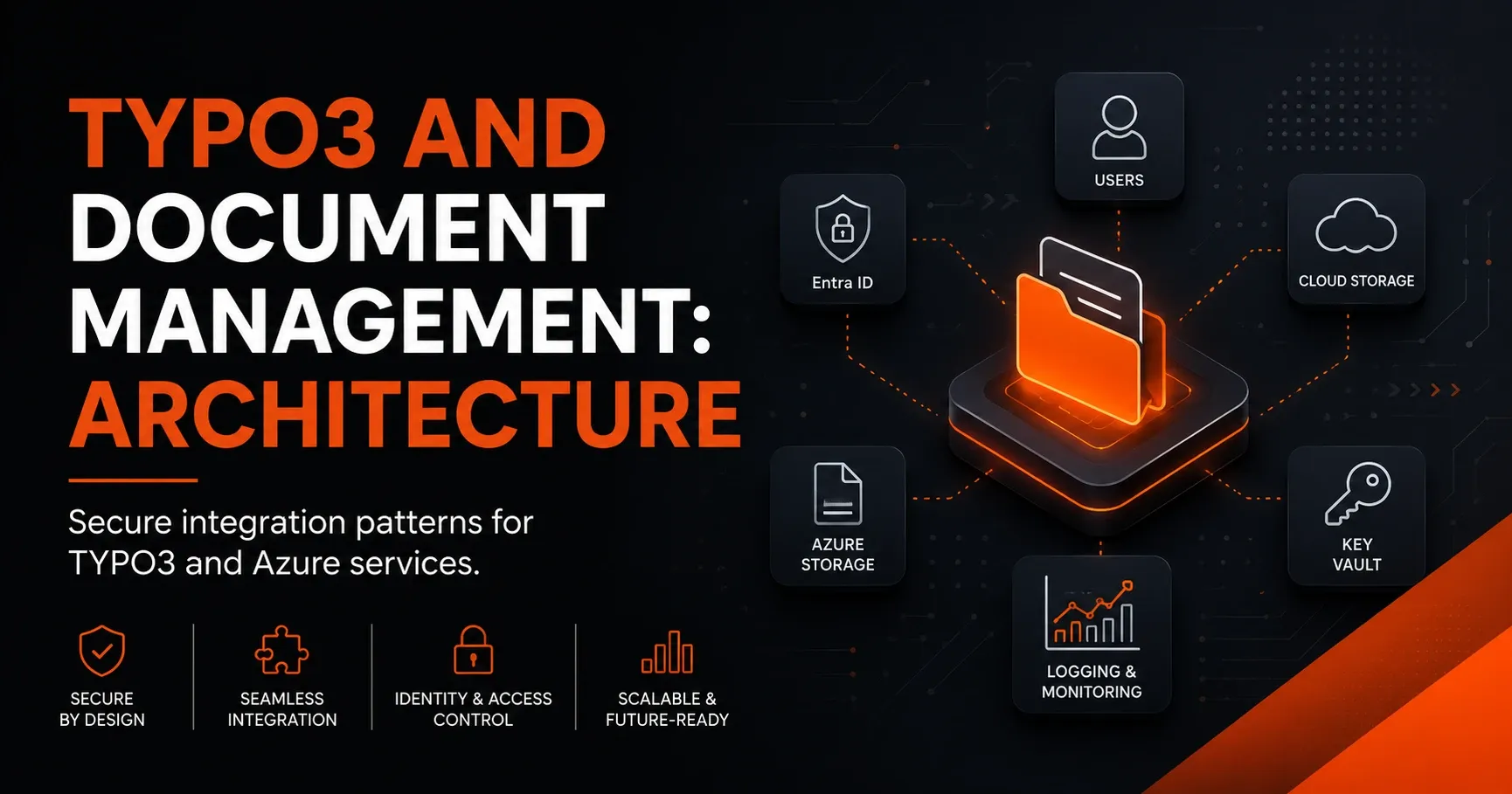
A modern architecture usually includes a TYPO3 frontend and backend, secure authentication via Azure AD, external storage such as Azure Blob Storage for documents, secret management via Azure Key Vault, and optional automation services such as Azure Functions or Logic Apps. Monitoring, logging, and governance components are added as well.
Division of tasks between TYPO3 and Azure
TYPO3 should not be misused as the primary file and document store when large volumes of data, high security requirements, or complex approval processes are involved. Instead, TYPO3 manages the content, references, and access, while Azure provides the physical storage and the infrastructure for processing and security. This separation improves maintainability, scalability, and compliance.
Secure integration patterns for TYPO3 and Azure Services
When integrating TYPO3 and Azure, secure patterns are especially important. Choosing the right integration approach affects not only performance, but also data protection, fault tolerance, and operational effort.
1. External document storage with Azure Blob Storage
A proven pattern is storing documents in Azure Blob Storage instead of the web server's local file system. TYPO3 then stores only the reference to the document, while the actual content resides in Blob Storage. This enables centralized, highly available, and scalable storage.
Advantages of this pattern include better scaling with large numbers of files, reduced load on the web server, easy integration with CDN or download scenarios, and granular access control through SAS tokens, managed identities, and network rules.[1]
2. Secure authentication via Azure AD
For protected document areas, Azure Active Directory or Microsoft Entra ID is a strong solution. Users sign in centrally, and TYPO3 can assign roles, groups, and permissions based on the Azure identity. This allows internal portals, partner areas, or B2B downloads to be secured with a consistent identity solution.
This pattern is especially useful when TYPO3 serves as a portal for employees, customers, or partners and documents should only be visible after successful login. Single sign-on also improves usability.
3. Token-based document delivery
For sensitive documents, delivery should not happen via open public URLs. Instead, a token-based access pattern is recommended. TYPO3 generates or brokers time-limited access tokens that allow downloads only for authorized users and only for a specific period.
This pattern significantly increases security because links are not permanently valid and can be controlled more effectively. Combined with Azure Blob Storage and CDN or proxy mechanisms, secure and high-performance delivery can be built.
4. Event-driven processing with Azure Functions
When new documents are uploaded or metadata changes, an event-driven architecture can be useful. Azure Functions can be triggered automatically to validate, convert, classify, or tag files.[2] TYPO3 merely initiates the process, while Azure handles the processing.
This is especially helpful for OCR workflows, PDF generation, image optimization, or automatic checks for format and size rules. TYPO3 stays lean and focuses on content logic.
5. Manage secrets and configuration securely with Azure Key Vault
A key security principle is outsourcing sensitive configuration data to Azure Key Vault. Connection strings, API keys, certificates, and secrets are stored securely there.[3] TYPO3 should never contain hardcoded credentials in code or unprotected configuration files.
By using Managed Identities, TYPO3 or connected middleware can access secrets without having to manage passwords itself. This reduces risk and supports modern secret management.
Architecture principles for resilient TYPO3 Document Management
A good architecture is not only technically functional, but also maintainable in the long term. Especially for enterprise solutions with high compliance requirements, a clear architectural approach is worthwhile.
Separation of presentation, logic, and storage
TYPO3 should act as the presentation and control layer, while business logic processes are moved to services or APIs. The document store, in turn, belongs in a dedicated storage solution such as Azure Blob Storage. This separation promotes modularity and prevents a monolithic system design.
Least privilege and role-based access
Secure document management relies on least privilege. Users, editors, administrators, and systems receive only the permissions they truly need. Azure AD groups, TYPO3 backend permissions, and storage policies should be aligned consistently so that no unnecessary access is granted.
Encryption in transit and at rest
Documents and metadata must be protected both in transit and at rest. TLS secures communication between TYPO3, Azure, and end users. Azure Blob Storage provides encryption at rest, while Key Vault secures the management of keys and certificates.[4]
Audit logging and traceability
For regulated industries, complete traceability is essential. Who uploaded, edited, or downloaded a document? Which version was active when? By combining TYPO3 logging, Azure Monitor, and possibly additional audit mechanisms, these questions can be answered clearly.
Recommended integration architecture at a glance
A typical target setup for TYPO3 and Azure Services can look like this: TYPO3 runs in a containerized or virtualized environment, authenticates users via Azure AD, and communicates through a secured API layer with Azure Blob Storage. Sensitive configurations are stored in Azure Key Vault, process automation runs via Azure Functions or Logic Apps, and monitoring is centralized with Azure Monitor.
In an extended version, an API Management layer can also be placed in front to control interfaces, manage traffic, and enable versioning. For very large document volumes or international setups, content delivery can be optimized through CDN and regional storage accounts.
Best practices for implementation
To keep the integration of TYPO3 and Azure successful in the long term, several best practices should be considered. Documents should not be stored directly in the TYPO3 file system if scaling or compliance matters. Instead, an external, clearly secured storage solution is recommended.
Authentication and authorization should be centrally controlled via Azure AD or Entra ID. Secrets belong in Azure Key Vault, not in code repositories.[5] API communication should happen through clearly defined interfaces, ideally with versioning and error handling. Monitoring, backup, and recovery processes should also be planned from the start.
Consider performance and scalability
A document portal is often burdened by download spikes or large media inventories. Blob Storage, caching mechanisms, and asynchronous processing ensure that TYPO3 does not become a bottleneck. Caching metadata and minimizing synchronous API calls also contribute to performance.
Plan for compliance and data protection
Especially with personal or confidential documents, data protection, retention periods, and deletion concepts must be taken into account. Azure provides the technical foundation for this, but the architecture must deliberately reflect these requirements. This includes data classification, access control, logging, and clear responsibilities.
Typical use cases for TYPO3 and Microsoft Azure
The combination of TYPO3 and Azure is suitable for many scenarios. These include customer portals with protected downloads, internal knowledge platforms with version-managed documents, service portals with product information and manuals, and B2B platforms with role-based access to contracts, data sheets, or certificates.
It is also useful in marketing and sales environments, for example when brochures, media kits, or press materials need to be maintained centrally and delivered automatically. With Azure integration, these processes can be made efficient, secure, and scalable.
Conclusion: TYPO3 Document Management with Azure as a future-proof solution
A well-designed TYPO3 and Document Management architecture creates the foundation for secure, scalable, and maintainable enterprise solutions. Combined with Azure Services, it offers major advantages: secure authentication, external storage, automated processing, centralized secret management, and high operational flexibility.
Anyone who views TYPO3 not in isolation but as part of a modern cloud architecture can manage documents efficiently while also better meeting security and compliance requirements. Especially in the context of typo3-microsoft, this results in powerful solutions that optimally support both editorial processes and technical integration requirements.
Plan the right architecture for your project now
If you want to use TYPO3 with Microsoft Azure for document management, it is worth developing an architecture concept that considers security, scalability, and maintainability from the outset. This creates a solution that not only works today but also confidently meets future requirements.
Further reading
- TYPO3 and Power Automate: Secure Architecture for Azure Integrations
- Securely integrate TYPO3 and SharePoint Online: practical guide with Azure
- TYPO3 and Azure Key Vault: How to Protect Secrets in the Cloud
- TYPO3 and Microsoft 365: Scalable Architecture for Strong Integrations
Sources and references
- Microsoft Learn: Security recommendations for Blob storage (accessed 2 October 2026)
- Microsoft Learn: Azure Blob storage trigger for Azure Functions (accessed 2 October 2026)
- Microsoft Learn: About Azure Key Vault secrets (accessed 2 October 2026)
- Microsoft Learn: Azure Storage encryption for data at rest (accessed 2 October 2026)
- Microsoft Learn: Azure Key Vault basic concepts (accessed 2 October 2026)