TYPO3 and Microsoft Purview: Secure Architecture for Modern Cloud Governance
TYPO3 and Purview: Architecture
The combination of TYPO3 and Microsoft Purview opens up a modern, scalable, and secure architecture for digital content, metadata, and governance. Especially in complex environments with multiple Azure services, hybrid systems, and sensitive data, a clear integration architecture is crucial. Those who connect TYPO3 with Azure services benefit from a flexible platform for content management, compliance, data classification, and controlled approval processes.
In this article, we look at proven secure integration patterns for TYPO3 and Azure. The focus is on an architecture that combines security, traceability, and extensibility. It becomes clear: TYPO3 can be much more than a classic CMS. In conjunction with Microsoft Purview, it becomes a central building block for governance, data quality, and structured content processes in the cloud.
Why combine TYPO3 with Microsoft Purview?
As an enterprise CMS, TYPO3 is particularly strong in managing complex websites, multilingual content, and editorial workflows. Microsoft Purview complements these strengths with functions for data governance, data cataloging, lineage, and information protection. Together, they create an architecture that not only publishes content, but also controls, classifies, and makes it traceable.
For companies with compliance requirements, data protection regulations, or regulated processes, this combination is especially relevant. Typical scenarios include:
• central management of website content with sensitive metadata
• governance across multiple Azure services
• classification and protection of personal or confidential information
• auditable processes for content approvals and data usage
• integration of TYPO3 into existing Microsoft cloud architectures
Target architecture for a secure TYPO3-Azure setup
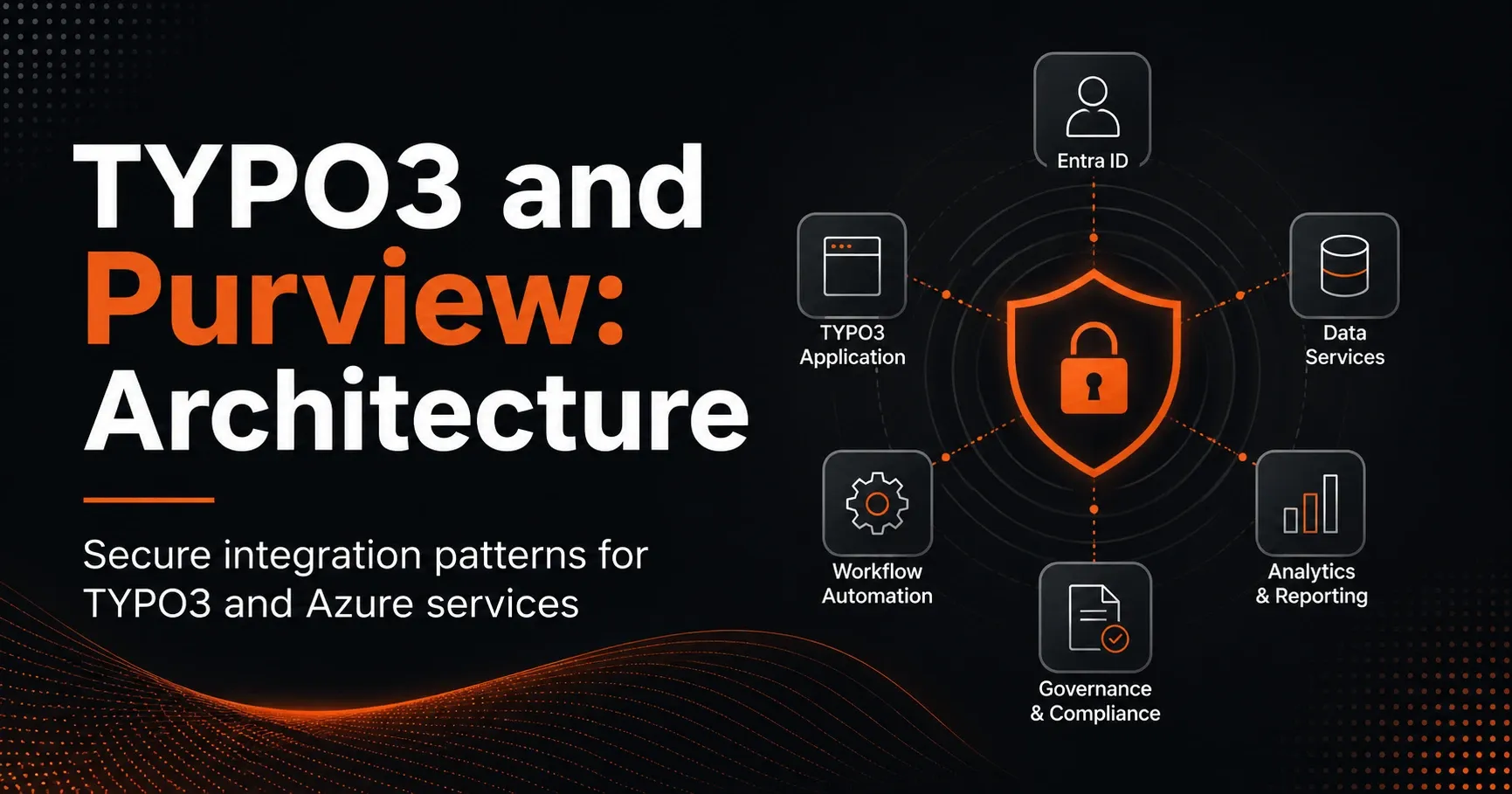
A robust architecture for TYPO3 and Azure services should clearly separate the presentation layer, application logic, integration layer, and governance layer. Microsoft Purview takes on the role of overarching control for data classification and compliance, while TYPO3 serves as the content and integration hub.
Recommended architecture components
A typical target architecture can include the following building blocks:
• TYPO3 frontend and backend for content management and editorial work
• Azure App Service or container environment for running the application
• Azure Key Vault for secure management of secrets, certificates, and connection data
• Azure API Management as a controlled interface for external and internal APIs
• Microsoft Purview for classification, cataloging, and governance
• Azure Monitor and Log Analytics for observability and auditing
• Azure Entra ID for identity and access management
Separation of responsibilities
An important architectural principle is the separation of responsibilities. TYPO3 should not access all internal systems directly, but should communicate via defined interfaces. Sensitive data, access keys, and governance information are managed centrally in Azure. Microsoft Purview provides transparency about data sources, classifications, and data flows.
Secure integration patterns for TYPO3 and Azure
The security of an integrated solution depends largely on the integration patterns used. For TYPO3 and Azure, several patterns have proven effective and can be combined depending on the use case.
1. API-first integration
An API-first approach is especially suitable when TYPO3 consumes data from other Azure services or passes content on to downstream systems. Azure API Management can be used to secure, version, and monitor APIs. TYPO3 does not access backend systems directly, but instead uses standardized endpoints.
The advantages of this pattern are:
• clear decoupling of systems
• better maintainability and scalability
• central authentication and authorization
• simpler logging and monitoring
2. Event-driven architecture
An event-driven architecture is well suited for dynamic content workflows. When content is published, changed, or approved in TYPO3, events can be sent to Azure services. This allows follow-up processes such as indexing, classification, notifications, or archiving to be automated.
Typical Azure components in this pattern are Azure Service Bus, Event Grid, or Azure Functions. These services enable scalable and reactive processes without requiring TYPO3 to handle complex background logic itself.
3. Secure proxy pattern
If TYPO3 works with particularly sensitive data, a secure proxy should be placed between the frontend and backend. The proxy validates requests, protects internal services, and ensures that no uncontrolled direct access occurs. In Azure, this role can be implemented through API Management, Application Gateway, or a Function solution with restrictive policies.
4. Zero Trust integration
A modern TYPO3-Azure architecture should follow the Zero Trust principle. This means that no system or user is automatically considered trustworthy. Every request must be authenticated, authorized, and traceable. Microsoft Entra ID, conditional access, and role-based permissions are central elements here.
The role of Microsoft Purview in the architecture
Microsoft Purview is not just a tool for data cataloging, but a strategic governance layer. In combination with TYPO3, Purview can help better understand and protect content, metadata, and data sources.
Data classification and sensitivity labels
When TYPO3 processes content with personal data, confidential documents, or internal information, classification should be applied. Purview supports assigning sensitivity labels that can be used to classify content by protection need. This makes it possible to define policies for storage, sharing, and access.
Data lineage and traceability
In complex cloud environments, transparency about data flows is essential. Purview provides data lineage and makes it clear where data comes from, how it is processed, and where it is sent. For TYPO3, this means editorial and integration processes can be documented and audited more effectively.
Cataloging data sources
When TYPO3 pulls content from CRM, DMS, ERP, or analytics systems, Purview helps catalog these sources. This gives teams a unified overview of data inventories, responsibilities, and quality attributes. It simplifies governance processes and reduces risks from shadow IT.
Secure identity and access architecture
The secure integration of TYPO3 and Azure depends on a clean identity concept. Instead of local user management, Microsoft Entra ID should be used as the central identity source wherever possible. This supports single sign-on, multi-factor authentication, and conditional access.
Recommended measures
• role-based access control for editors, administrators, and integration services
• use of managed identities for Azure resources
• storing secrets exclusively in Azure Key Vault
• short token lifetimes and regular rotation of credentials
• logging of all privileged actions
It is particularly important that TYPO3 is never operated with hard-coded credentials. The secure separation of application and secrets is a fundamental requirement for a resilient cloud architecture.
TYPO3 hosting in Azure: proven operating models
TYPO3 can be operated in Azure in different ways. The choice of operating model depends on requirements for scalability, maintenance, cost, and security level.
Azure App Service
For many projects, Azure App Service is a good choice. It offers a managed runtime, automatic scaling, and integrated security features.[1] Combined with external storage and managed services, it creates a lean, low-maintenance architecture.
Container-based operation
For those who need more flexibility, TYPO3 can be run in containers on Azure Kubernetes Service or in other container environments. This model is especially suitable for large platforms, custom deployments, and complex CI/CD processes. Clean network policies, image scanning, and secured secret management are important here.
Hybrid scenarios
Many companies already have existing on-premises systems. In such cases, TYPO3 can be connected as a cloud component to local systems through secure interfaces. Purview helps make data flows between the cloud and the data center transparent and enforce governance requirements.
Compliance, data protection, and governance
The integration of TYPO3 and Microsoft Purview is especially valuable when data protection and compliance play a central role. Typical requirements include GDPR compliance, internal policies, retention periods, and audit obligations.
GDPR and information protection
By combining classification, access control, and logging, personal data can be better protected. Purview helps identify sensitive content and define appropriate protection measures. TYPO3, in turn, can design editorial processes so that only authorized people have access to critical content.
Auditability and compliance
A major advantage of the architecture is improved auditability. Changes to content, access rights, and data processing can be documented in a traceable way. For industries with high compliance requirements, such as public administration, finance, or healthcare, this is a significant benefit.
Best practices for implementation
To ensure the architecture remains viable in the long term, a few best practices should be considered during implementation.
1. Integrate security early into the architecture
Security should not be added afterward, but be part of the design from the start. This includes network segmentation, secure authentication, encryption, and clear approval processes.
2. Automate governance
Wherever possible, policies and checks should be automated. Azure Policy, Purview scans, and CI/CD checks help detect and correct deviations early.
3. Document interfaces clearly
Clean API documentation reduces integration risks and makes maintenance and operations easier. This is especially true when multiple Azure services, external partners, and complex content flows are involved.
4. Establish monitoring and alerting
Without continuous monitoring, a secure architecture remains incomplete. Logs, metrics, and alerts should be evaluated systematically to detect anomalies, errors, or security incidents quickly.
5. Define roles and responsibilities
Editorial, operations, development, and governance need clear responsibilities. Only then can approvals, changes, and security measures be implemented efficiently.
Typical use cases for TYPO3 and Purview
The combination of TYPO3, Azure, and Purview is suitable for numerous enterprise scenarios. It is especially interesting wherever content is not viewed in isolation, but as part of a larger data and process ecosystem.
• corporate websites with sensitive documents and forms
• portals for customers, partners, or employees
• multilingual platforms with central governance
• specialist portals connected to Azure-based data sources
• compliance-driven information portals in the public sector
Conclusion: secure architecture creates lasting value
A well-designed TYPO3-Purview architecture combines content management, cloud integration, and governance into a future-proof platform. Microsoft Purview extends TYPO3 with transparency, classification, and compliance capabilities, while Azure services provide the necessary scalability, security, and automation.
Companies that integrate TYPO3 with Azure and Purview benefit from a clear separation of system boundaries, secure access paths, and traceable data flows. The result is a modern digital architecture that is not only powerful, but also auditable and governance-ready.
Anyone investing today in a secure and flexible integration architecture lays the foundation for sustainable digital processes, better compliance, and a stable future for the platform.
Further reading
- TYPO3 and Power Automate: Secure Architecture for Azure Integrations
- TYPO3 and Microsoft 365: Scalable Architecture for Strong Integrations
- TYPO3 and Intune: How to achieve a secure Microsoft architecture
- TYPO3, Microsoft 365, and Defender: The Architecture for Secure Enterprise Publishing
Sources and references
- Microsoft Learn: App Service overview (accessed 2 October 2026)